Tuesday, September 20, 2011

Aphid

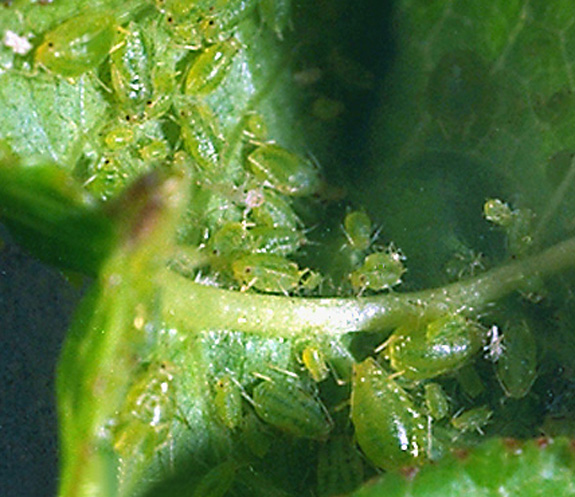
Magnified picture of live aphids.

Corpses of aphids (white ones) on bell pepper leaves.

  Aphid is a sap sucking insect that is destructive to many of cultivated plants.  In our case, cucumbers, tomatoes, and bell peppers all suffer aphid infestation.  In Merom, Carl mixed chemical in the fertilizer tank that, upon absorption by plants, kills aphids when aphids suck on phloem.  On the other hand, he used Aphidius ervi, a biopesticide solution in the 248 greenhouse.

  Biopesticide is generally a better solution than chemical pesticides because it is less stressful to plants.  Some chemical pesticides may affect workers' health and require license to spray, but bugs are harmless.  The downside of biopesticide is the cost.  Not only product itself is more costly than the chemical pesticide, but also the application takes labor.  For example, we need to use several workers to spread the bottle bugs equally in the greenhouse, whereas we can simply mix the chemical pesticides in the fertilizer (except for the spraying type).

Importance of Space and other Needs for Plants

  From what Carl has taught us about understanding the plants' needs, we need to imagine and to relate ourselves to plants:  If we are a plant in a greenhouse, what would we need?  For example, there will be weeks of hot weather during summer, and how would we know if the greenhouse is too hot?  The answer is simple: If we, the workers in the greenhouse, can feel the heat and the need to cool down and drink more water, the plants will need to as well.

  As silly as it may sound initially, treating plants as someone like us is easier for us to understand their needs.  Space for plants must not be neglected - cramming too many plants per square meter will result in plants not getting enough sunlight in the future.  We all want huge output,but 2.5 - 2.6 plants per meter squared seems to be the recommended density.

  Plants do get stressed out as well.  According to Kyra, when the weather gets very hot, ~27 degrees celcius and above, plants are usually stressing at that point.  If we pick or prune or twiddle when the plants are stressing, it usually results in the plants "giving up" and they end up not producing anymore output.  This is important to note, and it is the reason why workers do not usually do anything with the plants after 2pm, which is when it gets really hot.

  Plants also need sufficient space above them called buffer.  Note the picture below:  The space above the plants' heads to the beams supporting the roof is the buffer zone.  Buffers are important for the air to mix inside the greenhouse for stable and equal temperature and heat throughout the greenhouse, which is aided by fans hanging above the plants.  The larger the buffer, the better it is for the plants.  For example, tomatoes need huge buffers to prevent their heads from overheating and killing the plant since they grow very tall. 

Poly sheets covering that is used for protecting against
scorching sunny days or containing the heat
inside the greenhouse during cold weathers.

  Notice the sheets that is being dragged slowly to the right.  This poly sheet wears out every 2 years and needs to be replaced.  It protects the greenhouse from heavy sun rays and also prevents the heat from leaving the greenhouse during cold days. 

More sheets at the side, but this is always there and
only replaced and taken down during clean up.
Note the generous buffer zone for the plants.

Saturday, September 17, 2011

Fertilizer in Merom

  Fertilizer is one of the most important aspect of greenhouse operation.  Plants draw most of their necessary energy from the Sun in the form of photosynthesis, but they still need certain kinds of minerals to grow.  According to Carl, the recipe differs by location of the greenhouse because the climate and sunlight level are different.  And of course, the recipe differs completely among different variety of plants.  The list below shows the current recipe Carl uses for the bell peppers in Merom:

Tank A:
IngredientsAmounts
Calcium Nitrate (liquid Ca)2 container (1390kg * 2)
Potassium Nitrate (KNO3)16 bags (25kg * 16)
Iron (liquid Fe)4 buckets (= 64 bags 25kg solid Fe)

Tank B:
IngredientsAmounts
Epsom Salt (MgSO4)*7H2O (Magnesium Sulfate, Heptahydrate)21 bags (25kg * 21)
Potassium Nitrate (KNO3)8 bags (25kg * 8)
Manganese1500g
Zinc3000g
Boron4200g
Copper600g
Potassium Chloride2 bags (25kg * 2)

  There are 4 tanks of fertilizer mix, A1, A2, B1, and B2.  We refill and mix A1 and B1 while A2 and B2 are in use for irrigation.  When A2 and B2 run out, we refill and mix them while using A1 and B1 for irrigation.  We do this (1) to keep the fertilizer up and ready the whole time and (2) because fertilizers take a day of mingle to fully dissolve in the tank.  The four tanks can contain over 4000 liters, and the recipe above is calculated to, after dissolved in water, produce 4000 liter of mixture.

Tank A1 with Iron.

Tank B2 with Potash.
  The reason why we separate tank is that calcium and iron are better not mixed with Epsom salt in high concentration.  When they do, they form a solid precipitation that is hard to dissolve in water.  If the concentration is low, the precipitation does not occur; that's why we mix them together with water at the merge point.

  Note that no ingredient in the recipe above is 100% pure.  For instance, potassium nitrate we use is composed of, according to the minimum guaranteed analysis, 13.7% nitrate nitrogen (N-NO3), 38.4% K, and 46.3% K2O.  The detail of each ingredient will be added.

  Also, it is good to know that the cost of fertilizer is about $5,000 for single A and B tanks.  In summer, we mix the fertilizers about 4-5 times per week.  All other seasons we do it about twice a week.  So in summer, it costs about $25,000 a week just to prepare the food for the plants.  Wow, they better produce the darn crops!

Irrigation in Merom

3 tanks containing water.

  There are 3 tanks containing enough water for 2 days in case of an emergency water cut off.  One tank contains returned water after irrigation (Carl calls it recert).  The other two contains a mixture of rain, city, and well water.  Well water this year contains high level of sodium, so we use Phosphoric acid during the fertilizer mixing process to lower the pH level before irrigating plants.

One of the filter pump stations.
  There are also 8 tanks of filter pumps that the mixed water with fertilizer goes through before heading to the plants.  These tanks contain filter sand that gets rid of tiny garbage that may clog the pipes.  The garbage could be weeds growing on the water, piece of construction material that went in the fertilizer tank, and so on.  The filter sand is replaced every year in the cleaning season (December).

Filter sand stock.
  The pure water and recert water merge at one point in the pipe.  Then the machine that monitors both the pH level of mixed water and the fertilizer draws just the right amount from the two to make the perfect mix for irrigation.  The perfect mix is stored in the large tank located in the irrigation room and sent off to the plants every so often.  Of course, the frequency and duration of irrigation depend on temperature, climate, plant conditions, and many other factors.

  We also have to occasionally clean out the tanks since weed will grow on the surface.
Dried sand-like weed that is thrown out from
the water tank.
They look very green and moldy in the tanks.
Weed in a tank of water already mixed with fertilizers.
  It is important to note that recert water from certain plants cannot be immediately reused to water certain plants.  For example, excess water used for watering tomato plants must not be used to water tomato plants again because there might be viruses from the plants that got into the recollection sewer.  According to Carl, a sterilizing system is the better choice to counter this problem since the payback is 3 years compare to just wasting water.  The sterilization can be done in multiple ways, one of which is ultraviolet radiation.  The following are some of the water we can and can't reuse for.


  • Bell pepper water can be reused to water bell pepper
  • Cucumber water can't be reused to water cucumber
  • Tomato water can't be reused to water tomato
  • Cucumber water can be reused to water tomato
  • Tomato water can be reused to water cucumber

  For more information about how the fertilizer is prepared, refer to the Fertilizer in Merom. (hyperlink to be added)

Friday, September 16, 2011

Stem Rot Disease


Several of the plants in 248 greenhouse are affected by stem rot disease.  The disease is fatal to the plants because once the plants gets it, they will die.  The bacteria grow in the stem to rot the stem, hence the name stem rot.  The disease is highly contagious, so it must be treated with care.  For instance, when removing the infected plants, we don't want to touch any other plants besides the infected ones, which may risk the epidemic of stem rot.

Water System for a Greenhouse

Currently at Merom, there is one giant big tank outside the facility for hot water circulation. The water is heated in the boiler room using natural gas instead of the wood burner since it's more cost efficient.  That tank is part of the enclosed heating system for the entire facility, including phase 1, 2 and 3. All the water is circulated, and the tank contains sensors for both the temperature and the water level. If the water level is below a certain level, alarm will notify the facility. The tank also contains 9 temperature sensors, making sure the water is not boiling but kept at a relatively high temperature, around 92-98 Celcius.The water must not boil since it's an enclosed system and the air is not pressurized in the tank.

Hot Water Tank
If the water level drops below a certain level, then we know there is a leakage somewhere in the system since everything is enclosed and all water does not escape. Natural gas is used to heat up the water, and it mixes with cold water in a mixing valve to obtain the desire temperature before sending the water off to the heating pipes to heat up the greenhouse.


Tuesday, September 13, 2011

Cutting Leaves Off

Cutting the leaves off for Kasja, a variety of long English is pretty much the same task as doing so for minis.  Today, we cut the leaves off to about my chest height so that we could continue to lower the plants.  We lower the plants to allocate more space for the heads to grow.  But the long English plants are already old (roughly 3 months) and are not producing as much as when they were young.  Also, stem rot disease is spreading and more than 15 plants are withered.

That being said, I doubt the effectiveness of today's operation.  According to Kyra, we want plant energy to concentrate on top and therefore trim off excess parts from the plants up to certain height.  But leaves are the producer of the energy, and to trim them off means to cut short the energy supply.  In order to verify the sanity of this action, I would have to investigate further.

Trimmed naked up to chest height.
As we trim, we also look for crooked, molded, and any defective cucumbers to get rid of.  We also get rid of other junks like suckers at the root.